NOT BUILT — PHASE 4/5

AI Synthetic Data Testing That Validates Fraud Models Without Production Risk

Stella Simulant — Senior AI Staging & Simulation Lead

Your data science team cannot test fraud models properly. Production data carries privacy risk. Manual test datasets miss edge cases.  Validation cycles take weeks. Stella Simulant generates privacy-safe synthetic test data that matches production fidelity, covers fraud edge cases, and validates models 75% faster. Deploy in 30 days. No production data required.


24 Stella Simulant_Hero section_superhuman image (1)
profile

Stella Simulant

Senior AI Staging & Simulation Lead

coming soon

75%

Faster Model Validation

High

Synthetic Data Fidelity

100%

Fraud Edge Case Coverage

Pre-Deploy

False Positive Reduction

30 days

Deployment Timeline

Metrics from target production model. Based on financial services fraud model testing patterns.
Trusted by Teams across Banking, Fintech, Insurance, and Global Trade
Logo 1 Logo 2 Logo 3 Logo 4 Logo 5 Logo 6 Logo 7 Logo 1 Logo 2 Logo 3 Logo 4 Logo 5 Logo 6 Logo 7
THE PROBLEM

The Problem Your Data Science Team Faces Every Day

Your fraud models are only as good as the data you test them with. According to Gartner, over 60% of AI projects in financial services are delayed due to insufficient test data quality and privacy constraints. Your team cannot safely use production data in testing environments, and manually curated test sets miss the edge cases that cause false positives in production.

Meanwhile, fraud attackers evolve their techniques daily.


No safe test data

Using production data in test environments violates GDPR, CCPA, and PCI DSS. Anonymized data loses the statistical properties that make testing meaningful. According to the World Economic Forum, synthetic data will power 60% of AI development by 2030.


Slow validation cycles

Manual test dataset creation takes weeks. Every model update requires hand-crafted scenarios that never
fully cover the fraud landscape. Releases are delayed, and the team ships with incomplete confidence.


Missing edge cases

Production data contains whatever fraud patterns have already occurred — not the novel attacks your model will face tomorrow. Rare fraud types are underrepresented in historical data, leaving your model blind to the threats that matter most.

JOB DESCRIPTION 

What Stella Simulant Does — Job Description

Stella Simulant is a Senior AI Staging & Simulation Lead that operates inside your model development pipeline as a dedicated testing and validation specialist.

STELLA SIMULANT 

Senior AI Staging & Simulation Lead  | FF-STG

 Not Built (Phase 4/5))

Squad

 Threat  

Reports To

Your CTO / Head of Data Science / QA

Works With

Model registry, CI/CD pipeline,
fraud detection systems

Deployed In

30 days (shadow mode first) 

KEY RESPONSIBILITIES

01

Generate synthetic test data that matches production statistical distributions without containing real customer information   

02

Validate fraud models 75% faster with on-demand scenario-specific test datasets


03

Cover fraud edge cases and novel attack vectors that production data cannot provide

04

Reduce pre-deployment false positives by testing against comprehensive synthetic scenarios before release

05

Track regression test pass rates per release with audit-ready validation reports   

AUTONOMY MODEL

Low risk —  Acts autonomously (generate data, run regression suites, report)

Medium risk — HITL by default (configurable) 

High risk —  ALWAYS human review (non-negotiable)

   You configure the threshold per model

Kill switch : Disable instantly

PERFORMANCE METRICS

Measured Performance — Not Promises

These metrics are from Stella Simulant's target production model for regulated financial services fraud model testing.

75%
Model Validation Speed
faster
Production
Synthetic Data Fidelity
Production- matching statistical distributions
Comprehensive
Fraud Edge Case Coverage
scenario generation
Measurable
Pre-Deploy False Positive Reduction
reduction before release
Per
Regression Test Pass Rate
release tracked
Novel
Attack Vector Simulation
pattern generation
Zero
Privacy Compliance
real customer data in testing
100%
Audit Trail Coverage
every test logged

Model: Generative models with statistical distribution matching | Inputs: Transaction schemas, fraud patterns, model configs, test scenarios, historical attack vectors | Target validation: Phase 4/5 deployment

HOW IT WORKS

How AI Synthetic Data Testing Works with Stella Simulant

Stella Simulant connects to your model development pipeline as a sidecar — no data migration, no production data exposure. Here is how every validation cycle flows:

01

Ingest

Transaction schemas, historical fraud patterns, model configurations,
  test scenarios, and historical attack vectors flow into Stella
  Simulant via API. No real customer data enters the testing pipeline
  — only structural and statistical metadata.

02

Generate

Stella Simulant produces synthetic datasets that match production statistical distributions using generative models. This includes rare fraud patterns, novel attack vectors, and edge cases that production data cannot provide in sufficient volume. Every synthetic record is statistically valid but contains zero real personally identifiable information.


03

Validate

Every fraud model under test is scored against the synthetic dataset:
  • Detection accuracy against known fraud patterns
  • False positive rate against legitimate transaction profiles
  • Edge case handling for rare and novel attack types
  • Regression against previous model versions
Your team configures the pass/fail thresholds per model, per scenario, per release.

04

Evidence

 Every validation run produces:
  • A model validation report with accuracy, precision, and recall
  • Synthetic data fidelity score versus production distributions
  • Edge case coverage map showing tested versus untested scenarios
  • Regression comparison against the previous production model
  • An immutable, tamper-evident audit trail for model governance
Your model governance team gets the evidence. Your data science team ships with confidence.


Want to See This on Your Fraud Models?

Run Stella Simulant in shadow mode — 30 days, no risk, no production data required. Compare synthetic validation results against your current testing process.

COMPLIANCE & REGULATORY MAPPING

Regulatory Frameworks Supported

AI synthetic data testing in regulated industries requires more than speed — it requires privacy compliance and model governance rigor. Every synthetic dataset and validation report Stella Simulant produces is documented with regulatory-grade evidence.

 GDPR

GDPR

Privacy-by-design synthetic data with zero personally identifiable information

CCPA

CCPA

Consumer data protection compliance in test environments

PCI DSS

PCI DSS

Cardholder data never enters test environments

DORA

DORA

Model resilience testing and validation documentation

EU AI Act

EU AI Act

Model testing transparency and bias assessment

NIST AI Risk Management Framework

NIST AI Risk Management Framework

Model validation and risk assessment documentation

YOUR ANALYST'S VIEW

What Your Data Science Team Sees

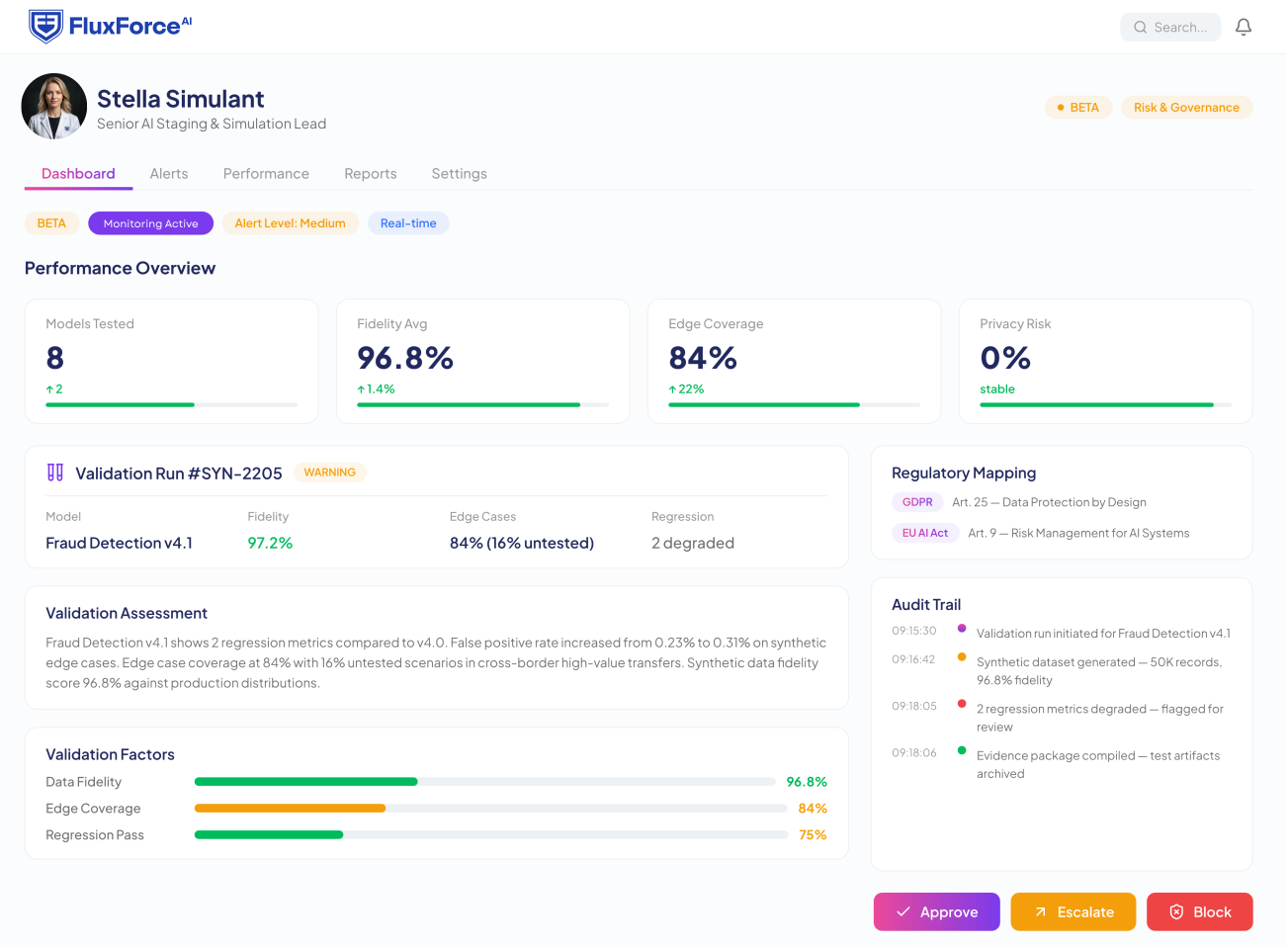
dash board1.23

Better data. Faster validation. Every test documented.

BEFORE vs AFTER  

BEFORE STELLA SIMULANT 

  • Weeks to validate 
  • Production data risk 
  • 40% edge case coverage  
  • Manual test datasets 
  • No regression tracking 

AFTER STELLA SIMULANT         

  •  Days to validate (75%)
  • Zero privacy exposure 
  • Comprehensive coverage 
  • On-demand generation  
  • Per-release pass rate 

 ROI — AI SYNTHETIC DATA TESTING vs HIRING vs LEGACY TOOLS

AI Synthetic Data Testing Cost Comparison — 2026

How does Stella Simulant compare to hiring QA/data engineers or using manual testing workflows?

Criteria  Hire 3 QA/Data Engineers Manual Test Workflow Stella Simulant 
   Annual cost   $480K-$900K (salary + benefits) $100K-$250K (tools + time)  $12K/year 
Validation cycle  2-4 weeks per model 1-3 weeks per model 30 days 
Edge case coverage  Limited by historical data Manual scenario creation ML-based predictiv
Privacy risk High (production data in test) Medium (anonymized data) Unlimited 
Regression tracking Manual comparison  Partial 100% automated, continuous 
Scales with models    Hire more ($$) More manual effort Per-service, real-time, auditable 
   Available 24/7   No    No    Auto-scales
  Learns from patterns   Yes (slowly)   No   Yes (predict + respond)
  Audit trail   Manual, inconsistent    Partial   Yes (continuous)


Key insight:According to Glassdoor, the average salary for a machine learning engineer in the United States is $130,000-$180,000 per year. A team of 3 QA and data engineers costs $480K-$900K annually before benefits. Stella Simulant validates fraud models 75% faster with comprehensive edge case coverage and zero privacy risk.

WORKS BEST WITH

Agents That Work Best with AI Synthetic Data Testing

Stella Simulant delivers maximum impact when paired with these FluxForce SuperHumans:

Devon Pulse

Lead AI DevSecOps Pipeline Architect

Secures the CI/CD pipeline that deploys the models Stella validates

Learn now

Aiden Flux

Senior AI Fraud Risk Analyst

The primary fraud detection agent whose models Stella validates before deployment

Learn now

Sol Runnr

Senior AI Service Reliability Engineer

Ensures the Services running Stella's validated models stay reliable

Learn now
TRUST BUILDERS

 Built for Regulated Financial Model Testing

Configurable Autonomy

Low risk: Stella acts autonomously (generate data, run tests, report).
Medium risk: HITL by default (configurable).
High risk: Always human review for production deployment approvals. You set the threshold per model, per scenario, per release..

Kill Switch

Disable Stella Simulant instantly. No system impact. No downtime. One click.

Shadow Mode

Run Stella Simulant alongside your existing testing workflow for 30 days. Observation only — generates synthetic data and validates models without changing your current process. Compare results.

Explainability

Every synthetic dataset includes a statistical fidelity report showing how closely it matches production distributions. Every validation result includes detailed reasoning for pass, warning,or failure classifications.

Audit Trail

Every dataset, test run, and result logged with immutable, tamper-evident evidence chain. Regulation → model → test data → result → outcome.

No Migration

Sidecar integration. Stella Simulant reads from your existing model registry and schemas. Your production data stays untouched.

Insights on AI Security,Compliance
& Financial Automation

Keep up with the latest AI trends, insights, and conversations.

Read Insights star
AI Insights star

DORA compliance for banks: 7 ICT risk requirements to meet now

AI Insights star

Zero Trust banking: how CISOs secure core systems in 2026

AI Insights star

AML transaction monitoring: how AI cuts false positives by 60%

Questions? We Have Answers star

Frequently Asked
Questions

AI synthetic data testing works by generating statistically accurate test datasets that mirror the distributions, patterns, and edge cases found in production transaction data — without containing any real customer information. Stella Simulant by FluxForce ingests transaction schemas, historical fraud patterns, and model configurations to produce synthetic test data that validates fraud model accuracy, false positive rates, and edge case handling before deployment.
Synthetic data eliminates the privacy and regulatory risk of using real customer data in testing environments. Under GDPR, CCPA, and PCI DSS, exposing production data in non-production environments creates compliance liability. Synthetic data generated by Stella Simulant maintains statistical fidelity to production distributions while containing zero real personally identifiable information.
AI synthetic data testing can accelerate model validation by up to 75% compared to traditional testing workflows that rely on manually curated test datasets. Stella Simulant generates scenario-specific test data on demand, including rare fraud patterns and edge cases that would take months to accumulate in production data, reducing validation cycles from weeks to days.
Yes. One of the primary advantages of AI synthetic data testing is the ability to generate edge cases and rare fraud scenarios that occur too infrequently in production to provide adequate model training and validation data. Stella Simulant can simulate novel attack vectors, unusual transaction patterns, and low-frequency fraud types to stress-test models before they encounter these patterns in production.
AI synthetic data testing uses configurable autonomy. Low-risk activities like generating standard test datasets and running regression suites are handled autonomously. Medium-risk activities like modifying model configurations default to human-in-the-loop review but can be configured for autonomous action. High-risk activities like approving models for production deployment always require human sign-off — this is non-negotiable in regulated environments. The institution controls the threshold.
Synthetic data fidelity measures how closely generated test data matches the statistical distributions, correlations, and patterns in production data. High fidelity means the synthetic data produces the same model behavior as real data — ensuring test results are predictive of production performance. Stella Simulant by FluxForce tracks fidelity as a core KPI and validates every synthetic dataset against production distributions before using it for model testing.
FluxForce pricing is customized based on transaction volume, regulatory requirements, and deployment model. Contact our team for a tailored quote.
AI Synthetic Data Testing —75% Faster Validation. 30-Day Trial.