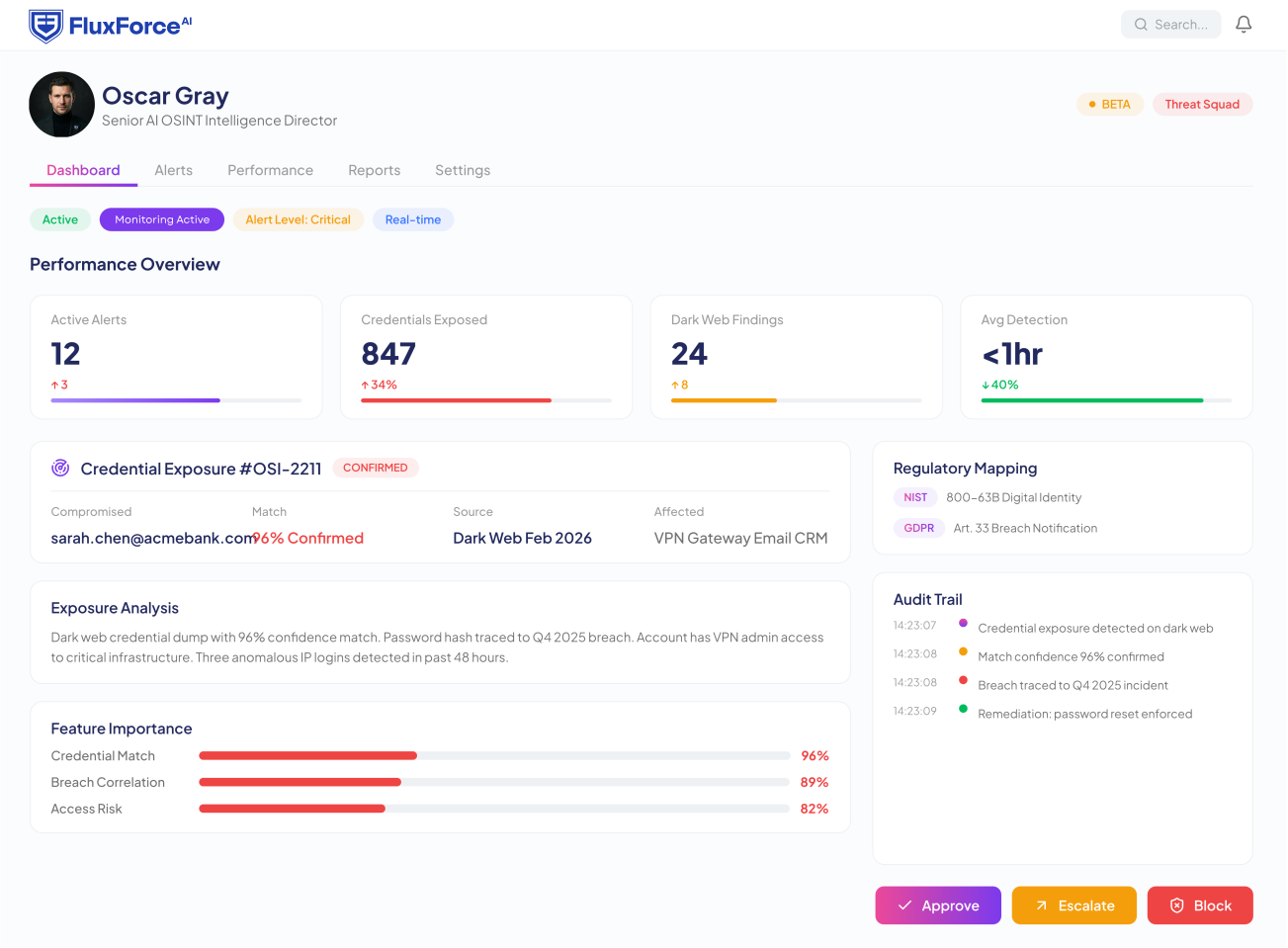
Your institution's biggest threats do not announce themselves at the firewall. Compromised credentials appear on the dark web. Customer data surfaces in breach dumps. Fraud rings coordinate on encrypted channels. Oscar Gray detects compromised credentials in under 1 hour, correlates breach and dark web data with your customer base, and enriches every
risk signal with external intelligence. No blind spots.

.png?width=2000&height=2000&name=6%20Oscar%20Gray_Hero%20section_superhuman%20image%20(1).png)
FF-OSI | Senior AI OSINT Intelligence Director
Credential Compromise Detection
Breach/Dark Web Correlation
Threat Intel Enrichment Coverage
OSINT Confidence Scoring
Intel-to-Risk Score Latency
Your security team focuses on what happens inside the perimeter. But the most dangerous threats originate outside — compromised credentials sold on the dark web, customer data leaked in breaches, and fraud toolkits shared on underground forums. According to the Identity Theft Resource Center, data breaches exposed over 1.1 billion records in 2024 alone.
Most institutions discover compromised credentials days or weeks after exposure — long after attackers have used them.
Employee and customer credentials appear in breach databases and dark web marketplaces. Without continuous monitoring, your institution discovers compromises days or weeks after exposure. According to IBM, the average time to identify a breach is 204 days. Attackers act in minutes.
Most financial institutions lack the tools and expertise to monitor the dark web, correlate breach data, and integrate external intelligence into risk decisions. According to Europol, cybercrime targeting financial services increased 35% in 2024. Without OSINT, your detection is limited to what happens inside your network.
Even when external intelligence is available, it sits in separate systems — disconnected from fraudm scoring, AML screening, and incident response. The intelligence exists but does not enrich decisions. Risk scores miss the external context that would make them actionable.
JOB DESCRIPTION
Oscar Gray is a Senior AI OSINT Intelligence Director that operates as a dedicated external intelligence specialist for your financial crime team.
Senior AI OSINT Intelligence Director | FF- OSI
Reports To
Your CRO / Head of Financial Crime
Works With
Existing fraud detection, AML, SIEM,
and incident response systems
Deployed In
30 days (shadow mode first)
KEY RESPONSIBILITIES
Detect compromised credentials in under 1 hour by monitoring breach databases and dark web marketplaces continuously
Correlate external intelligence with internal customer and employee databases — matching exposures to specific accounts
Enrich fraud, AML, and security signals with multi-source OSINT context and confidence scoring
Normalize confidence levels across disparate intelligence sources for consistent risk assessment
Integrate intelligence into risk scoring with <500ms latency — real-time enrichment
AUTONOMY MODEL
Low risk — Acts autonomously (approve, clear)
Medium risk — HITL by default (configurable)
High risk — ALWAYS human review (non-negotiable)
You configure the threshold per rule
Kill switch : Disable instantly
These metrics are target specifications for Oscar Gray's production model.
Model: Multi-source OSINT fusion with entity resolution | Data : Breach DBs, dark web feeds, sanctions lists, IP/domain intel | Status : Phase 2 roadmap — design specifications
HOW IT WORKS
Oscar Gray operates as an always-on intelligence layer — collecting, correlating, and enriching external signals for your financial crime team. No data migration required. Here is how intelligence flows:
Oscar Gray continuously ingests data from breach databases, dark web marketplaces and forums, sanctions lists, social network profiles, IP/domain intelligence feeds, and public records. Collection runs 24/7 across both surface and deep web sources.
Raw OSINT signals are correlated against your institutional customer and employee databases using entity resolution. Compromised credentials, exposed PII, and threat actor intelligence are matched to specific accounts and identities within your institution.
Matched intelligence is enriched with confidence scoring, source
reliability assessment, and contextual analysis. Oscar Gray normalizes confidence levels across disparate sources — converting raw data into risk-scored intelligence your systems can act on.
Enriched intelligence feeds into your fraud detection, AML screening, and incident response systems. Intel-to-risk-score integration latency is under 500ms. Every intelligence finding produces an immutable audit trail with source, confidence, and action taken.
Get early access to Oscar Gray. We will run an initial OSINT scan
on your institution — showing what is already visible externally.
AI OSINT intelligence in regulated financial services requires responsible collection and handling of external intelligence data. Every intelligence finding Oscar Gray produces is mapped to the applicable regulatory and security framework.
Threat intelligence integration (Identify/Detect functions)
ICT risk monitoring and threat detection requirements
Financial crime indicator monitoring
Threat actor TTP mapping and classification
Data protection for OSINT involving personal data
Transparency requirements for AI-driven intelligence
YOUR ANALYST'S VIEW
See what is exposed. Before the attacker uses it.
BEFORE vs AFTER
BEFORE OSCAR GRAY
AFTER OSCAR GRAY

ROI — AI OSINT INTELLIGENCE vs HIRING vs LEGACY TOOLS
How does Oscar Gray compare to hiring threat intelligence analysts or using legacy dark web monitoring services?
| Criteria | Hire 3 Intel Analysts | Legacy Dark Web Service | Oscar Gray |
|---|---|---|---|
| Annual cost | $480K-$960K (salary + benefits) | $100K-$300K (subscription) | Custom pricing |
| Deployment time | 3-6 months (recruit + clearance + train) | 4-8 weeks (integration) | 30 days |
| Credential detection speed | Hours to days (manual) | Hours to days (batch) | <1 hour |
| Dark web coverage | Analyst-dependent | Vendor-dependent | Comprehensive, 24/7 |
| Correlation with internal data | Manual, inconsistent | Limited API integration | Automated entity resolution |
| Confidence normalization | Manual assessment | Vendor scoring only | Cross-source normalized |
| Integration latency | Hours (manual workflow) | Minutes to hours | <500ms |
| Scales with volume | Hire more ($$) | Plan upgrades ($$) | Auto-scales |
| Learns from data | Yes (slowly) | No | Yes (continuous) |
Key insight: According to IBM's Cost of a Data Breach Report 2024, the average cost of a data breach in financial services is $6.08 million. Organizations with threat intelligence programs reduce breach costs by an average of $244,000. Oscar Gray provides continuous, institution- specific OSINT intelligence at a fraction of the cost of a dedicated analyst team - and detects exposures in under 1 hour rather than days.
Oscar Gray delivers maximum impact when paired with these FluxForce SuperHumans:
Enriches Aiden's fraud scoring with external intelligence — breach data, dark web signals,and credential exposure.

Maps every KYC/AML screening decision to the full regulatory landscape across jurisdictions.

Feeds credential compromise data into Zero Trust access decisions — blocking compromised credentials instantly
Low risk: Oscar acts autonomously (routine scans, no matches).Medium risk: HITL by default (configurable). High risk: Always human investigation. You set the threshold per intelligence type, per source, per severity.
Disable Oscar Gray instantly. No system impact. No downtime.One click.
Run Oscar Gray on your customer/employee base for 30 days.Observation only — no alerts to end users, no actions. Validate detection accuracy before going live.
Every intelligence finding includes source attribution, confidence scoring, and correlation evidence. Your security team can verify the chain from raw OSINT to actionable alert.
Every finding logged with immutable, tamper-evident evidence chain. Source → correlation → confidence → action → outcome.
Sidecar integration. Oscar Gray reads your existing identity
databases and integrates with your risk systems via API. Your core systems stay untouched.
Keep up with the latest AI trends, insights, and conversations.
Read Insights