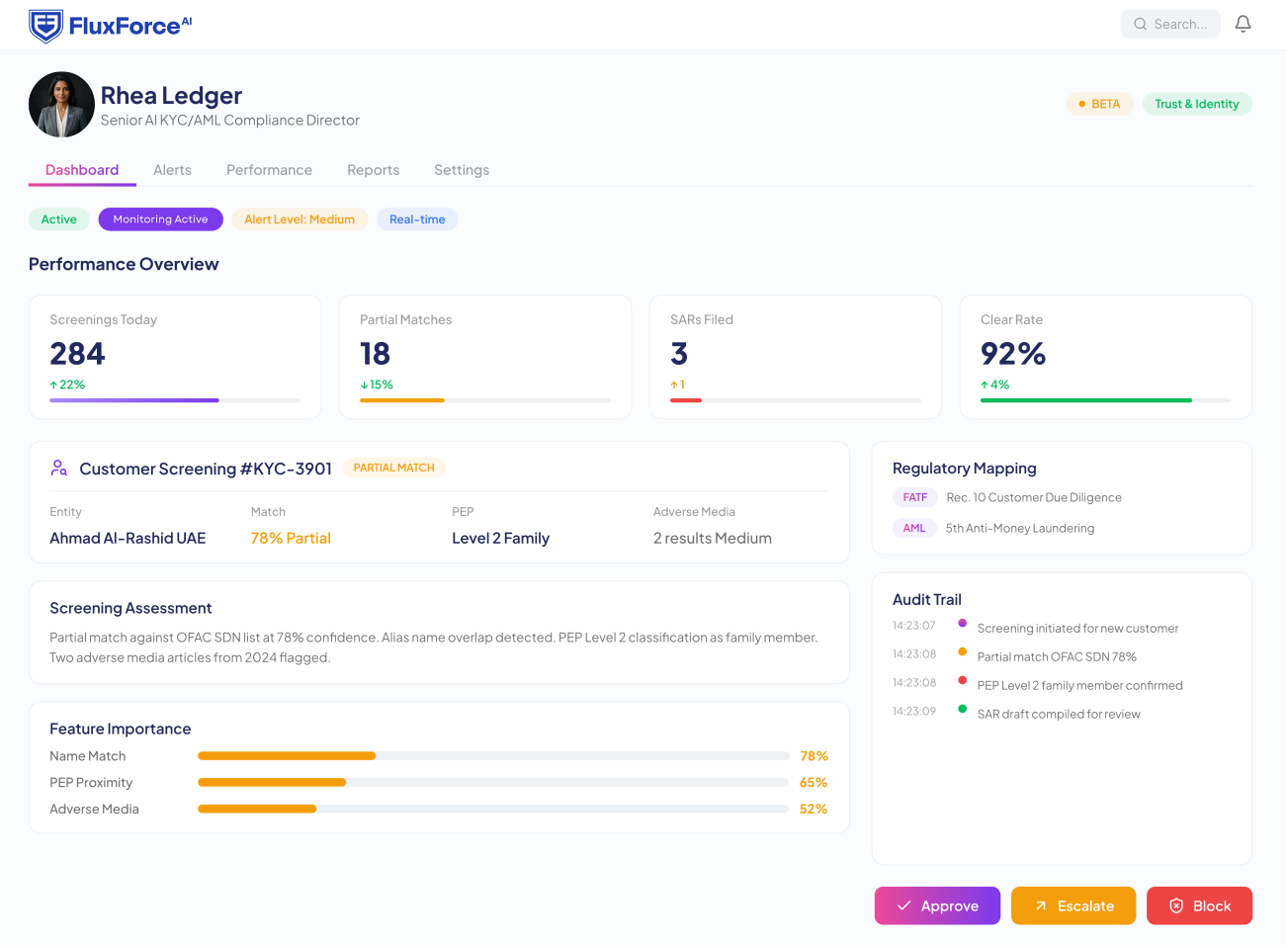
Your compliance team screens thousands of customers against sanctions lists that change daily. Entity resolution failures mean real hits are missed — and false positives waste investigator time. Rhea Ledger screens every customer with 100% sanctions and PEP coverage, drafts SARs in minutes not hours, and monitors adverse media in real time. KYC refresh goes from quarterly snapshots to continuous monitoring.

.png?width=2000&height=2000&name=5%20Rhea%20Ledger_Hero%20section_superhuman%20image%20(1).png)
Senior AI KYC/AML Compliance Director
Sanctions/PEP
Entity Resolution
SAR/CTR
Adverse Media
KYC Refresh
Your compliance analysts screen hundreds of customers daily against sanctions lists that update without warning. Entity names have variants, transliterations, and aliases. According to FinCEN, US financial institutions filed over 4.6 million SARs in 2024 — a 15% increase year-over-year. Each SAR takes 4-8 hours to prepare manually.
Meanwhile, adverse media about your existing customers appears between quarterly reviews.
Entity resolution failures mean real sanctions hits are missed while false positives overwhelm investigators. According to FATF, poor entity resolution is among the top causes of sanctions screening failures globally. Name variants, transliterations, and alias mismatches create both false negatives and false positives.
Each SAR takes 4-8 hours of analyst time to research, draft, and document. According to FinCEN, the volume of SARs has grown 78% over the past decade, but compliance headcount has not kept pace. Analysts burn out. Quality deteriorates.
Quarterly or annual KYC reviews create blind spots. A customer designated as a PEP on Tuesday is not flagged until the next quarterly review cycle. Real-time sanctions changes, adverse media, and behavioral shifts require continuous monitoring — not snapshots.
JOB DESCRIPTION
Rhea Ledger is a Senior AI KYC/AML Compliance Director that operates
inside your compliance infrastructure as a dedicated screening and monitoring specialist.
Senior AI KYC/AML Compliance Director | FF- KYC
Reports To
Your CCO / Head of AML
Works With
Existing KYC platform, screening
tools, and case management systems
Deployed In
30 days (shadow mode first)
KEY RESPONSIBILITIES
Screen every customer against OFAC, EU, UN, and 200+ global sanctions and PEP lists with 100% coverage
Resolve entity ambiguities using probabilistic matching — reducing both false positives and false negatives
Draft SARs and CTRs in minutes with pre-compiled evidence and FinCEN-mapped narrative templates
Monitor adverse media and watchlist changes in real time — not quarterly
Shift KYC from periodic review to continuous event-driven monitoring
AUTONOMY MODEL
Low risk — Acts autonomously (approve, clear)
Medium risk — HITL by default (configurable)
High risk — ALWAYS human review (non-negotiable)
You configure the threshold per rule
Kill switch : Disable instantly
These metrics are target specifications for Clara Adjusta's production model.
Model: Entity resolution + NLP adverse media analysis | Data : Sanctions lists, PEP databases, watchlists, adverse media feeds | Status : Phase 2 roadmap — design specifications
HOW IT WORKS
Rhea Ledger connects to your existing KYC/AML infrastructure as a sidecar — no data migration, no core system changes. Here is how every customer is screened and monitored:
Customer PII from your onboarding or CRM system feeds into Rhea Ledger via API. Every customer is screened against OFAC, EU, UN, and 200+ global sanctions and PEP lists. Screening happens at onboarding and continuously thereafter.
Entity resolution algorithms match customer identities against watchlists using probabilistic matching. Name variants, transliterations, and aliases are evaluated contextually — using date of birth, nationality, and associated entities to reduce false positives while ensuring no true hits are missed.
Post-onboarding, Rhea Ledger continuously watches for:
• New sanctions designations and PEP status changes
• Adverse media from news, courts, and regulatory sources
• Transaction pattern anomalies suggesting AML risk
• Watchlist updates applied within 1 hour of publication
KYC refresh shifts from quarterly to continuous, event-driven.
When suspicious activity is detected, Rhea Ledger:
• Auto-generates SAR/CTR drafts in minutes
• Pre-compiles transaction evidence and narrative summaries
• Maps every filing to FinCEN/FATF requirements
• Produces an immutable audit trail for examiner review
Get early access to Rhea Ledger. Be first in line when Phase 2 launches.
We will notify you when shadow mode testing begins.
AI KYC/AML screening in regulated institutions requires more than speed — it requires provable compliance with anti-money laundering and sanctions regulations worldwide. Every decision Rhea Ledger makes is mapped to the regulatory framework that applies.
Bank Secrecy Act anti-money laundering requirements
Office of Foreign Assets Control sanctions compliance
Financial Action Task Force 40 Recommendations
Sixth Anti-Money Laundering Directive
Insurance fraud prevention best practices
Explainable AI requirements for compliance automation
YOUR ANALYST'S VIEW
100% coverage. Better matches. Every screening decision explained.
BEFORE vs AFTER
BEFORE RHEA LEDGER
AFTER RHEA LEDGER

ROI — AI KYC AML SCREENING vs HIRING vs LEGACY TOOLS
How does Rhea Ledger compare to hiring compliance analysts or using legacy screening platforms?
| Criteria | Hire 3 AML Analysts | Legacy Screening Platform | Rhea Ledger |
|---|---|---|---|
| Annual cost | $450K-$900K (salary + benefits) | $200K-$600K (license + data feeds) | Custom pricing |
| Deployment time | 3-6 months (recruit + train) | 6-12 months (implementation) | 30 days |
| Sanctions coverage | Manual list management | Vendor-dependent | 100% across 200+ lists |
| Entity resolution | Manual, inconsistent | Basic fuzzy matching | Probabilistic ML matching |
| SAR draft time | 4-8 hours per filing | Template-based | Minutes |
| KYC refresh cycle | Quarterly/annual | Periodic batch | Continuous, event-driven |
| Adverse media | Manual searches | Batch/periodic | Real-time |
| Scales with volume | Hire more ($$) | License tiers ($$) | Auto-scales |
| Learns from data | Yes (slowly) | No | Yes (continuous) |
Key insight: According to a 2024 LexisNexis study, the average cost of AML compliance for a mid-size US bank exceeds $35 million per year. A significant portion of this cost is analyst time spent on false positive investigations and SAR preparation. Rhea Ledger reduces both — better entity resolution means fewer false positives, and auto-generated SAR drafts free analyst time for genuine investigations.
Rhea Ledger delivers maximum impact when paired with these FluxForce SuperHumans:
Links transaction fraud intelligence to customer-level AML risk profiles — connecting the dots between fraud and AML .

Maps every KYC/AML screening decision to the full regulatory landscape across jurisdictions.

Low risk: Rhea acts autonomously (clear screenings, no hits).Medium risk: HITL by default (configurable). High risk: Always human compliance officer review. You set the threshold per screening type, per risk tier, per jurisdiction.
Disable Rhea Ledger instantly. No system impact. No downtime. One click.
Run Rhea Ledger on your live customer base for 30 days.
Observation only — no filings, no action. Validate accuracy
before going live.
Every screening result includes plain-English reasoning with
match confidence scores and contributing factors. Your compliance team and examiners can read why each customer was cleared, flagged, or escalated.
Every decision logged with immutable, tamper-evident evidence chain. Regulation → rule → evidence → action → outcome.
Sidecar integration. Rhea Ledger reads your existing customer data and screening feeds. Your core systems stay untouched.
Keep up with the latest AI trends, insights, and conversations.
Read Insights