NOT BUILT — PHASE 4

AI Claims Fraud Detection That Finds What Adjusters Miss

Clara Adjusta — Senior AI Claims Intelligence Officer

Your claims team processes thousands of claims monthly. Fraud hides in
plain sight — duplicate filings, staged events, inflated damages. Manual
triage catches some. Most slips through. Clara Adjusta scores every claim
at intake — reducing per-claim processing by 45% with a 90%+ SIU
referral true positive rate. Claims leakage savings quantified every
quarter.

4 Clara Adjusta_Hero section_superhuman image (1)
profile

Clara Adjusta

FF-CFD | Senior AI Claims Intelligence Officer

coming soon

High

Claims Fraud Accuracy

45%

Per-Claim Processing Reduction

90%+

SIU Referral True Positive

Real

Duplicate/Staged Catch Rate

Quarterly

Leakage Savings Report

Target metrics based on model design specifications. Phase 4 roadmap.
Trusted by Teams across Banking, Fintech, Insurance, and Global Trade
Logo 1 Logo 2 Logo 3 Logo 4 Logo 5 Logo 6 Logo 7 Logo 1 Logo 2 Logo 3 Logo 4 Logo 5 Logo 6 Logo 7
THE PROBLEM

The Problem Your Claims Team Faces Every Day

Your claims adjusters open their queues each morning to hundreds of new filings. Each claim needs triage — is it legitimate, suspicious, or fraud? According to the Coalition Against Insurance Fraud, insurance fraud costs the US industry over $308 billion annually. Most of it is never detected.

Meanwhile, your SIU team is overwhelmed with low-quality referrals.


Claims fraud undetected

Staged accidents, inflated damages, and phantom claims pass through manual review. According to the NICB , insurance fraud adds $400-$700 per year to the average family's premiums. Most fraud is detected only after payout — if at all.


Manual triage bottlenecks

Adjusters spend 30-60 minutes per claim on initial triage. At scale, this creates backlogs that delay legitimate claims and increase customer dissatisfaction. The triage process itself becomes a source of leakage.


Claims leakage

Overpayments, missed subrogation opportunities, and undetected fraud compound to erode profitability by 2-5% of total claims costs. According to McKinsey, AI-powered claims management can reduce leakage by 20-30% within 18 months of deployment.

JOB DESCRIPTION 

What Clara Adjusta Does — Job Description

Clara Adjusta is a Senior AI Claims Intelligence Officer that operates inside your claims pipeline as a dedicated fraud detection and triage specialist.

CLARA ADJUSTA 

Senior AI Claims Intelligence Officer | FF-CFD

 Not Ready

Reports To

 Your Head of Claims / CRO     

Works With

Existing claims management system ,policy admin,
and SIU workflows

Deployed In

30 days (shadow mode first)

KEY RESPONSIBILITIES

01

Score every claim for fraud probability at intake using ML and pattern analysis  

02

Reduce per-claim processing time by 45% through automated triage and routing


03

Achieve 90%+ true positive rate on SIU referrals — investigators focus on real fraud 

04

Detect duplicate claims, staged events, and inflated damages across the portfolio 

05

Quantify claims leakage savings per quarter with detailed evidence and audit trails

AUTONOMY MODEL

Low risk — Acts autonomously (approve, clear) 

Medium risk — HITL by default (configurable)  

High risk —  ALWAYS human review (non-negotiable)


You configure the threshold per rule

Kill switch : Disable instantly

PERFORMANCE METRICS

Target Performance — Design Specifications

These metrics are target specifications for Clara Adjusta's production model.

High
Claims Fraud Detection Accuracy
precision fraud scoring
45%
Per Claim Processing Reduction
reduction in processing time
90%+
Siu Referral True Positive Rate
of referrals are real fraud
High
Duplicate/Staged Claim Catch Rate
cross-portfolio detection
Quantified
Claims Leakage Savings
per quarter with evidence
<5 minutes
Triage Speed
per claim at intake
Auto-generated
Evidence Packing
SIU packages
100%
Audit Trail Coverage
every decision logged

Model: Multi-signal fraud scoring with entity resolution |  Training: Claims data + policy data + historical fraud patterns | Status: Phase 4 roadmap — design specifications

HOW IT WORKS

How AI Claims Fraud Detection Works with Clara Adjusta

Clara Adjusta connects to your existing claims management system as a sidecar — no data migration, no core system changes. Here is how every claim flows:

01

Ingest

Claims data from your CMS feeds into Clara Adjusta via API. Data
includes: claim details, policy information, coverage terms, historical claims for the policyholder, and supporting documentation (medical records, repair estimates, photos, police reports).

02

Score

Every claim is scored for fraud probability at intake. Clara Adjusta
applies ML models to detect duplicate filings, staged events, inflated damages, and suspicious provider patterns. Entity resolution links claimants, providers, and witnesses across the full claims history.


03

 Triage

Based on the fraud score, Clara Adjusta routes each claim:
  • Low risk → Fast-tracked for             standard processing
  • Medium risk → Flagged for             adjuster review (configurable)
  • High risk → Escalated to SIU           with complete evidence                   package (always)

Your team configures the threshold per claim type, per coverage line,
per geography.

04

Report

Every decision produces:
  • A fraud probability score with         contributing indicators
  • Entity relationship mapping             showing linked claims and               parties
  • Supporting evidence packaged        for SIU investigation
  • Quarterly leakage reports m            quantifying savings
  • Immutable audit trail for regulatory compliance.


Want to See This on Your Claims Data?

Get early access to Clara Adjusta. Be first in line when Phase 4 launches.
We will notify you when shadow mode testing begins.

COMPLIANCE & REGULATORY MAPPING

Regulatory Frameworks Supported

AI claims fraud detection in regulated insurance requires more than accuracy — it requires provable compliance with insurance regulations and data protection laws. Every decision Clara Adjusta makes is mapped to the regulatory framework that applies.

NAIC Model Laws

NAIC Model Laws

State insurance fraud reporting requirements

Solvency II

Solvency II

EU regulatory framework for insurer risk management

FCA Insurance Conduct

FCA Insurance Conduct

UK claims handling and fraud requirements

GDPR

GDPR

Data handling for policyholder and claimant data

IFPA Guidelines

IFPA Guidelines

Insurance fraud prevention best practices

EU AI Act

EU AI Act

Explainable AI for automated claims decisioning

YOUR ANALYST'S VIEW

What Your Claims Adjuster Sees

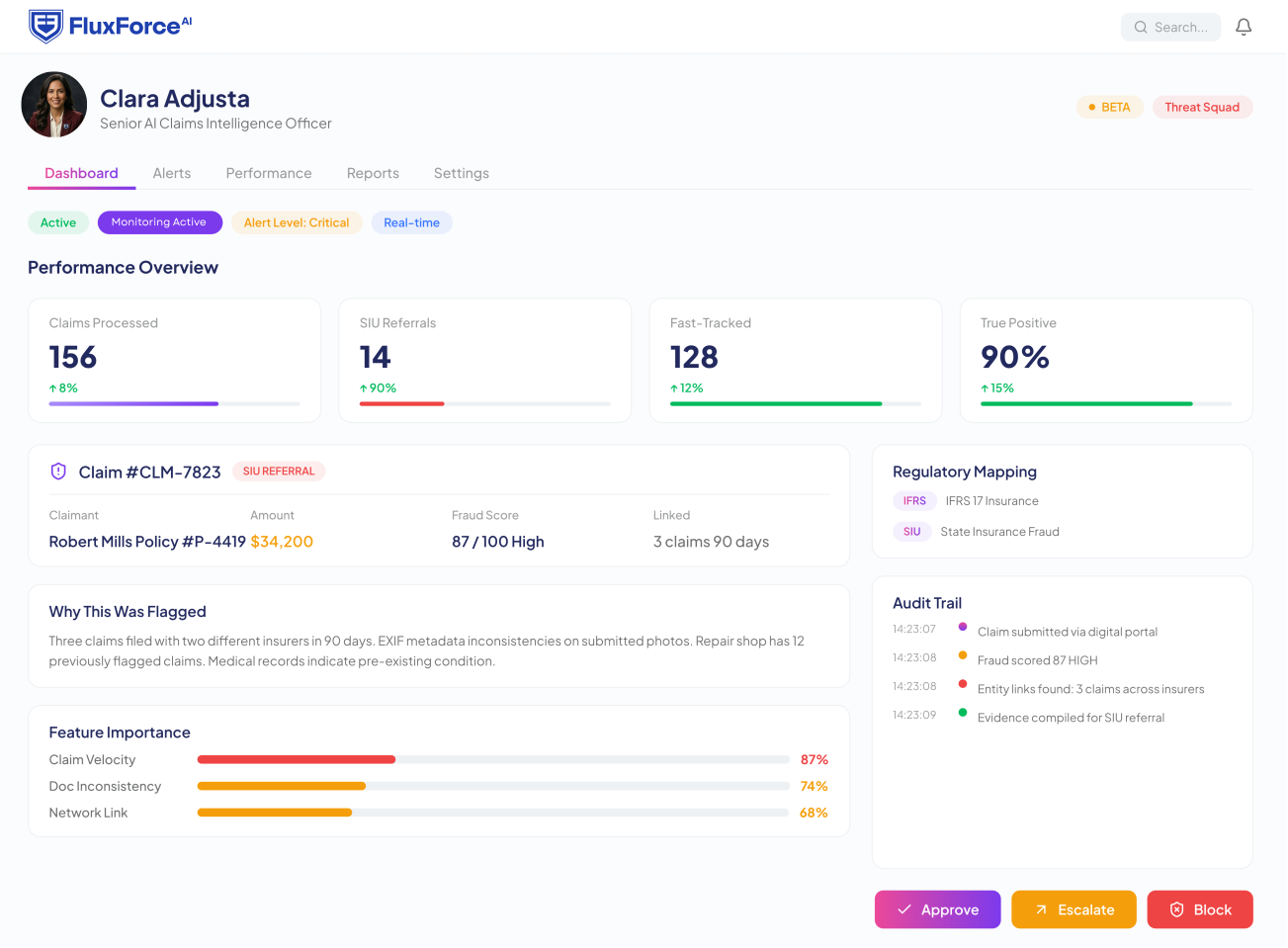
dashboard1.4-1

Fewer false referrals. Better SIU cases. Every triage decision explained.

BEFORE vs AFTER  

BEFORE CLARA ADJUSTA 

  •  30-60 min per triage 
  •  Low SIU accuracy  
  • Fraud undetected 
  • No leakage tracking 
  • Manual evidence  

AFTER LENA CREDIT

  • <5 min per claim 
  • 90%+ true positive 
  • Scored at intake 
  • Quarterly savings 
  •  Auto-packaged SIU case 

ROI — AI CLAIMS FRAUD DETECTION vs HIRING vs LEGACY TOOLS

AI Claims Fraud Detection Cost Comparison — 2026

How does Clara Adjusta compare to hiring SIU investigators or using
legacy fraud detection rules?

Criteria Hire 3 SIU Investigators  Legacy Rules Engine Clara Adjusta
    Annual cost $360K-$750K (salary + benefits)  $150K-$400K (license + maintenance)   TBD (Phase 4)
Deployment time 3-6 months (recruit + train) 6-12 months (implementation) 30 days
SIU referral accuracy Varies (experience dependent) 30-50% true positive 90% 
Per-claim processing 30-60 minutes manual Batch scoring, limited  45% reduction
Duplicate/staged detection Quarterly manual review Batch reporting Continuous, 30+ day warning
Leakage quantification     Estimated annually Not available Quarterly, evidence-based
  Scales with volume    Hire more ($$)   License upgrades ($$)    Auto-scales
  Available 24/7   No (shifts needed)   Yes    Yes
  Learns from data   Yes (slowly)   No    Yes (continuous)


Key insight:According to the Coalition Against Insurance Fraud, insurance fraud costs the US industry over $308 billion annually. Even a 1% improvement in fraud detection across a mid-size insurer's claims book can save millions per year. Clara Adjusta targets the three biggest leakage drivers: undetected fraud, triage inefficiency, and SIU false positives.

WORKS BEST WITH

Agents That Work Best with AI Claims Fraud Detection

Clara Adjusta delivers maximum impact when paired with these FluxForce SuperHumans:

Aiden Flux

Senior AI Fraud Risk Analyst

Enriches claims fraud scoring with real-time transaction fraud intelligence from across the institution 

Learn now

Oscar Gray

Senior AI OSINT Intelligence Director
Adds external intelligence — breach databases, dark web signals , and public records — to claims fraud claims fraud
Learn now

Zara Trustwell

Director AI Regulatory Compliance
Maps every claims decision to insurance regulatory frameworks and  ensures audit readiness.
Learn now
TRUST BUILDERS

Built for Regulated Insurance Companies

Configurable Autonomy

Low risk: Clara acts autonomously (fast-track routing). Medium risk: HITL by default (configurable). High risk: Always human SIU review. You set the threshold per claim type, per coverage line, per geography.

Kill Switch

Disable Clara Adjusta instantly. No system impact. No downtime.One click.

Shadow Mode

Run Clara Adjusta on your live claims for 30 days. Observation only — no routing, no action. Validate accuracy before going live.

Explainability

Every fraud score includes plain-English reasoning with contributing indicators and confidence levels. Your compliance team and regulators can read why each claim was fast-tracked, flagged, or escalated.

Audit Trail

Every decision logged with immutable, tamper-evident evidence chain. Regulation → rule → evidence → action → outcome.

No Migration

Sidecar integration. Clara Adjusta reads your existing claims feed and policy data. Your core systems stay untouched.

Insights on AI Security,Compliance
& Financial Automation

Keep up with the latest AI trends, insights, and conversations.

Read Insights star
AI Insights star

DORA compliance for banks: 7 ICT risk requirements to meet now

AI Insights star

Zero Trust banking: how CISOs secure core systems in 2026

AI Insights star

AML transaction monitoring: how AI cuts false positives by 60%

Questions? We Have Answers star

Frequently Asked
Questions

AI claims fraud detection works by analyzing claims data, policy information, historical patterns, and external signals using machine learning models. Clara Adjusta by FluxForce scores every claim for fraud probability at intake, cross-references against known fraud patterns, and identifies duplicate and staged claims automatically — achieving a 90%+ true positive rate on SIU referrals.
Claims leakage refers to overpayments, missed fraud, and processing inefficiencies that erode insurer profitability. According to the Coalition Against Insurance Fraud, insurance fraud costs the US industry over $308 billion annually. AI prevents claims leakage by catching fraud earlier, automating triage, and identifying overpayment patterns. Clara Adjusta quantifies leakage savings per quarter with detailed audit trails.
Yes. Traditional SIU referral processes produce high false positive rates, overwhelming investigation teams with non-fraudulent claims. AI improves SIU referral accuracy by applying multi-signal fraud scoring that evaluates claims against behavioral patterns, historical data, and external intelligence. Clara Adjusta achieves a 90%+ true positive rate on SIU referrals, ensuring investigators focus on genuine fraud.
AI-powered claims fraud detection reduces per-claim processing time by 45% by automating triage, fraud scoring, and documentation review. Manual claims triage typically takes 30-60 minutes per claim. Clara Adjusta scores claims at intake, routes low-risk claims for fast-track processing, and only escalates high-probability fraud to human investigators — freeing capacity across the claims operation.
Yes. AI detects staged and duplicate insurance claims by analyzing entity relationships, claim timing patterns, provider networks, and documentation inconsistencies across the entire claims portfolio. Clara Adjusta cross-references every incoming claim against historical claims data to identify duplicates, near-duplicates, and coordinated staging patterns that human reviewers miss at volume.
AI claims fraud detection is subject to insurance regulations including NAIC model laws in the US, Solvency II in the EU, FCA requirements in the UK, and the EU AI Act's transparency requirements for automated decision-making. Clara Adjusta maps every fraud scoring decision to the applicable regulatory framework with audit-ready documentation for compliance teams and regulators.
AI claims fraud detection uses configurable autonomy. Low-risk claims with clear patterns are triaged autonomously for fast-track processing. Medium-risk claims default to human-in-the-loop review but can be configured for autonomous routing. High-risk claims — including suspected staged events and large-value fraud — always require human SIU investigation. The insurer configures exactly where the threshold sits per claim type and coverage line.
AI Claims Fraud Detection 90%+ SIU Accuracy · 45% Faster.