.webp)








Listen To Our Podcast🎧
Introduction
In 2025, nearly all large enterprises experienced financial losses linked to AI risks, including compliance failures totaling $4.4 billion. The EU AI Act's full high-risk obligations become enforceable on August 2, 2026. Article 99 sets the penalty for breaching those obligations at up to €15 million or 3% of global annual turnover, whichever is higher. The headline €35 million or 7% tier applies only to the prohibited practices banned outright under Article 5.
This is why AI regulatory compliance 2026 has moved from a future concern to a present risk. Earlier, AI compliance lived with legal teams. In 2026, it lives inside operations.
New AI laws for enterprises directly affect how AI models are built, trained, deployed, and monitored. Teams now have to show:
- Why an AI system exists
- What data it uses
- How decisions can be reviewed
- Who is responsible when something goes wrong
When this is missing, AI systems slow down business instead of helping it.
Most Enterprises Lack Basic Control Over Their AI Systems
A common issue across large organizations is simple. No one has a full view of all AI systems running across teams.
This makes AI governance and regulation hard to follow. Without clear ownership and tracking, even low-risk AI can become a compliance issue. Risk leaders are now pushed to create structure where speed once ruled.
The Cost of Getting AI Compliance Wrong Is Rising Fast
The cost of non-compliance with AI regulations now has specific, verified figures rather than general warnings.
High-risk AI non-compliance under the EU AI Act can incur fines up to €15 million or 3% of global annual turnover. Limited-risk transparency violations risk up to €20 million or 4% of global turnover. Maximum penalties reach €35 million or 7% of global annual turnover.
Enterprises are learning this the hard way. Fixing AI compliance after systems are live is expensive and disruptive. This is why AI risk management is becoming part of everyday business decisions.
Stay ahead with FluxForceAI’s guide to AI regulatory compliance in 2026
ensure your enterprise remains compliant.

How to Prepare for AI Regulations 2026 Without Slowing the Business ?
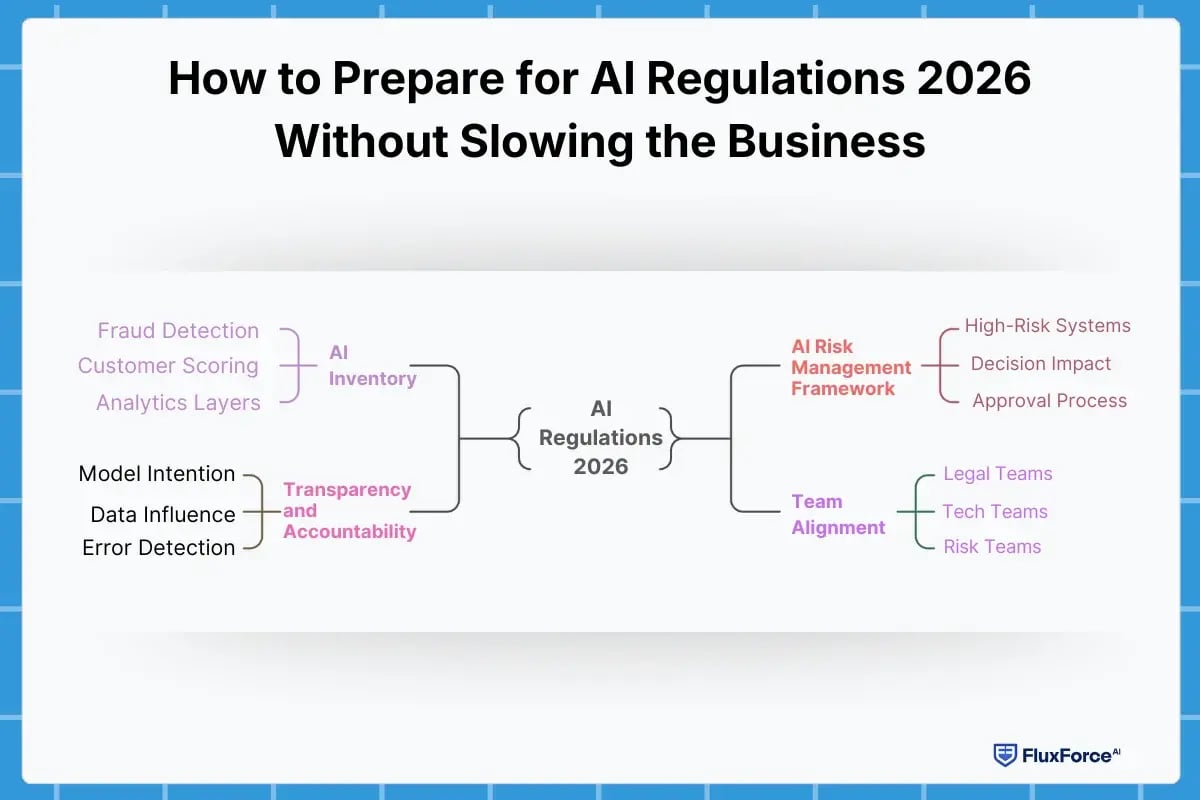
How to prepare for AI regulations 2026 is the most-searched practical question by enterprise compliance teams working against the august deadline. The answer follows a consistent sequence that organizations moving from awareness to structured compliance are applying now. New AI regulatory trends 2026 expect enterprises to prove control before incidents happen. This means preparation has to begin inside product, data, and risk teams, not after deployment.
The goal is simple. Stay compliant without killing speed.
Build an AI Inventory Before Writing Any Policy
Many organizations apply standard software development and procurement practices to AI without recognizing unique regulatory requirements. Missing design history is a critical gap — the technical documentation required by Annex IV demands comprehensive records of design decisions, data lineage, and testing methodologies.
Before any policy is drafted, every AI system currently in production or development must be catalogued: its function, the decisions it influences, the data it processes, and the population of people it affects. This inventory is not a one-time exercise. Every new AI tool procured, every API integrated, and every model retrained requires an inventory update. For AI model validation for regulatory compliance, this inventory is the starting document — without it, model risk management cannot be applied systematically.
Build an AI Risk Management Framework That Fits the Business
A generic framework does not work. Enterprises need an AI risk management framework that matches how decisions are made internally.
This includes:
- Identifying which systems are high-risk under EU AI Act requirements 2026
- Mapping decision impact on customers, employees, or markets
- Defining who approves, monitors, and overrides AI outcomes
This is where compliance and business strategy meet. Done right, it reduces friction instead of adding layers.
Embed Transparency and Accountability Early
Regulators now expect AI transparency and accountability by design.
This does not mean exposing algorithms. It means being able to explain:
- What the model is intended to do
- What data influences outcomes
- How errors or bias are detected
Enterprises that embed explainability early avoid painful rewrites later. This is becoming a core expectation under AI compliance standards globally.
Align Teams Before Regulations Force You To
One of the biggest blockers to AI compliance strategy for businesses is internal misalignment.
Legal teams think in laws. Tech teams think in performance. Risk teams think in exposure. In 2026, these teams must operate together.
Enterprises that align early move faster when new AI legal requirements arrive. Those that do not end up reacting under pressure.
EU AI Act Compliance in 2026: How Enterprises Operationalize It
In 2026, enterprises cannot afford compliance gaps. AI decisions now affect credit, fraud detection, trading, inventory, logistics, and operational reliability. Here’s how to approach it strategically.
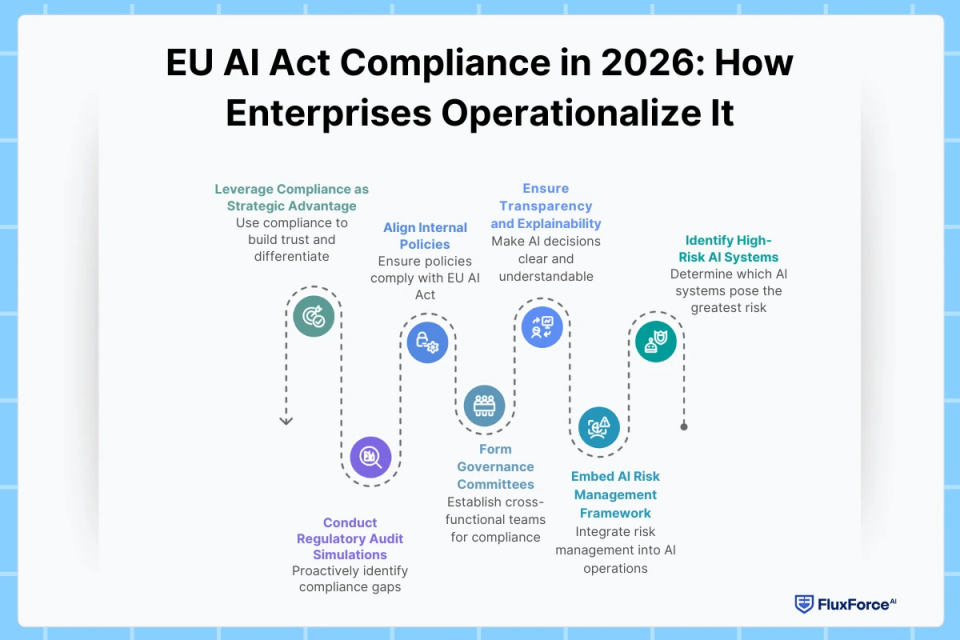
Identifying High-Risk AI Systems
Before you can manage compliance, you need to know which systems pose the highest risk. High-risk AI is typically involved in decision-making, anomaly detection, and predictive forecasting. These systems impact operational integrity and regulatory exposure.
-
Decision-making AI:
Systems affecting financial risk, approvals, or operational outcomes must meet transparency, explainability, and fairness standards.
-
Anomaly detection AI:
Systems detecting fraud, operational anomalies, or irregular patterns need continuous monitoring and human oversight. -
Predictive and optimization AI:
Systems forecasting demand, inventory, or operational performance require documented risk assessments and audit trails.
Embedding AI Risk Management Framework
Compliance isn’t a one-time checklist—it’s a continuous process. Embedding an AI Risk Management Framework (RMF) ensures that AI operations remain compliant throughout development, deployment, and monitoring stages.
- Risk detection and mitigation: Regular bias testing, fairness assessments, and continuous model validation.
- Documentation and audit readiness: Maintain detailed records of model decisions, data sources, and system updates.
- Operational integration: Embed checkpoints into development pipelines to make compliance continuous, not reactive.
Transparency and Explainability
No single team can manage AI compliance alone. Effective governance requires coordination between risk, legal, compliance, data science, and operational teams.
- Form cross-team governance groups including risk, legal, compliance, data science, and operations.
- Align internal policies with EU AI Act compliance.
- Conduct regular simulations of regulatory audits to proactively identify gaps.
Governance Committees and Cross-Functional Collaboration
No single team can manage AI compliance alone. Effective governance requires coordination between risk, legal, compliance, data science, and operational teams.
- Form cross-team governance groups including risk, legal, compliance, data science, and operations.
- Align internal policies with EU AI Act compliance.
- Conduct regular simulations of regulatory audits to proactively identify gaps.
Leveraging Compliance as a Strategic Advantage
Enterprises that integrate AI regulatory compliance into operations can gain trust, reduce risk, and differentiate themselves in the market.
- Demonstrate adherence to AI regulatory compliance 2026 to build stakeholder trust.
- Minimize costs of non-compliance with AI regulations through proactive governance.
- Position transparency and accountability as operational and reputational assets.
Why AI Regulatory Compliance Matters for Enterprises in 2026 ?
Compliance as the New Enterprise Baseline
Compliance-driven AI tools and governance markets are projected to grow by 25 to 30% annually through 2030. Over 65% of organizations plan to upskill employees for AI governance roles by 2026.
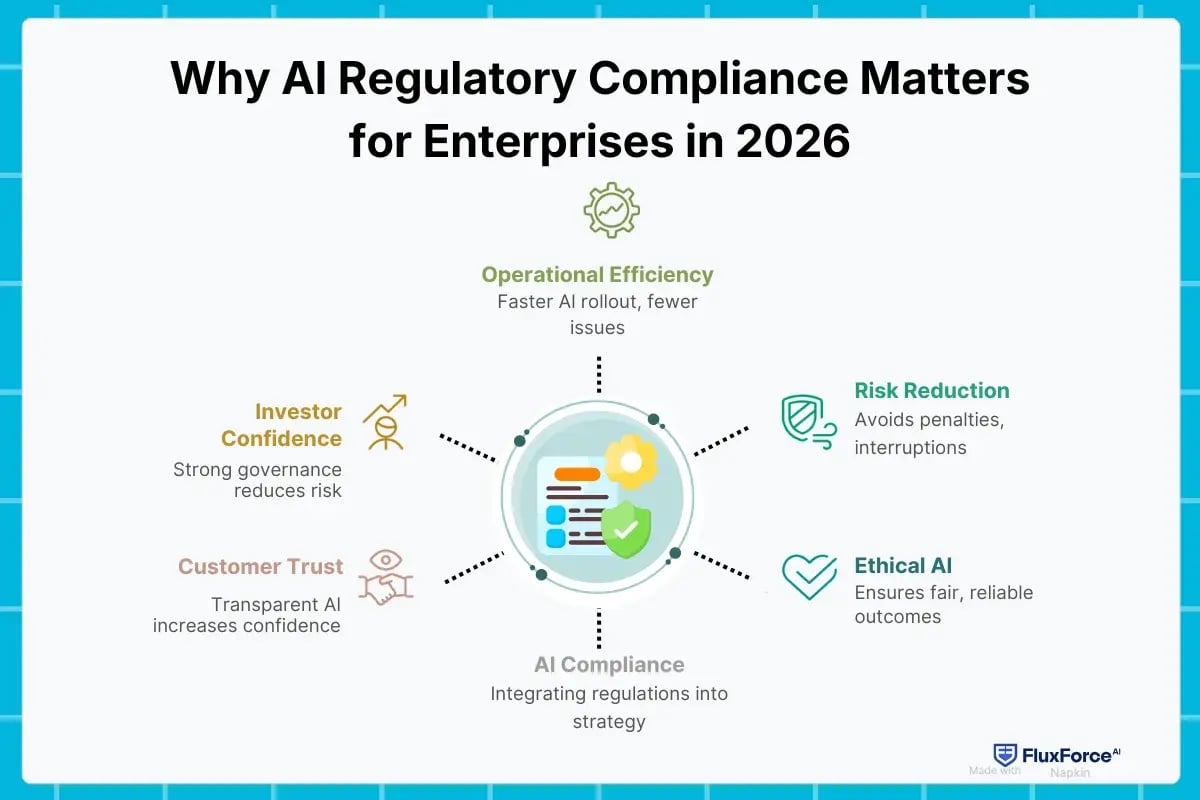
The enterprises treating AI regulatory compliance as a competitive differentiator in 2026 are identifying something the penalty-focused framing misses: markets where trust is central to customer relationships — financial services, healthcare, insurance — create commercial advantages for organizations that can demonstrate their AI operates transparently and fairly. Banks and fintechs that publish transparent AI governance frameworks attract enterprise customers whose own compliance programs require supplier AI transparency documentation.
Building an AI Governance Framework That Spans Jurisdictions
An AI governance framework for 2026 must address four jurisdictions simultaneously for most large enterprises: EU AI Act obligations for any AI affecting EU persons, US federal guidance from NIST AI RMF and sector-specific regulators (OCC, CFPB, SEC), US state laws including Colorado and emerging equivalents, and global frameworks including India's emerging AI regulations and China's Algorithm Recommendation provisions.
ISO 42001 provides the management system standard that maps to all four jurisdictions' governance expectations. NIST AI RMF's four functions (Map, Measure, Manage, Govern) satisfy the process documentation requirements that EU AI Act Annex IV and SR 11-7 both require. Organizations building their AI governance framework against ISO 42001 and NIST AI RMF simultaneously are building the documentation infrastructure that every major regulatory framework already references. See how AI governance for GRC programs connects this framework to day-to-day risk and compliance operations.
Understanding the Cost of Non-Compliance
Conformity assessments for high-risk AI systems cost between €5,000 and €50,000 per system. Large enterprises typically deploy 8 to 10 governance and compliance tools per AI system by 2026, increasing per-model costs. Organizations often spend tens of thousands annually per AI model on monitoring, audits, and documentation.
The cost comparison that drives strategic compliance investment: proactive AI regulatory compliance with documented governance programs typically costs $50,000 to $500,000 annually in compliance, legal, and consulting fees for large enterprises. A single EU AI Act violation for a high-risk AI system costs up to €15 million. The math makes proactive compliance straightforward for any enterprise with more than a handful of AI systems in production.
Organizations that reduce compliance costs through automation rather than manual documentation achieve the lowest total cost of compliance while maintaining the audit readiness that regulators require. The automation investment that cuts per-evaluation costs from thousands to as low as $3 per evaluation, according to SQ Magazine compliance cost analysis, is what makes continuous compliance economically viable at scale.
Stay ahead with AI regulatory compliance in 2026
Discover essential strategies and updates
Conclusion
As enterprises step into 2026, AI is both an opportunity and a responsibility. Regulatory frameworks such as the EU AI Act and evolving state and global laws are no longer optional checkboxes. They are essential rules that shape how AI can be safely and effectively used. For businesses, success depends on aligning AI innovation with compliance from the start. Organizations that embed AI governance, risk management, and monitoring into their workflows will not only avoid penalties but also gain trust, transparency, and a strategic edge.
The path forward is clear. Enterprises must understand their regulatory obligations, integrate them into AI operations, and continuously assess risks. Compliance is not just a legal requirement. It is a way to ensure AI drives growth safely, responsibly, and sustainably.
Organizations that take these steps today will enter 2026 ready to innovate confidently while keeping regulators, customers, and partners reassured.



Share this article